We have been sent an email containing an open letter addressed to the Standing Committee of the Sydney Anglican Diocese. The letter was written by Rev Dr Keith Mascord who will soon take up a role as the National Chaplain at Mission Australia.
We do not know Keith personally.
As the letter is an open letter, can I encourage you to read it! The letter is written in a good spirit addressing some specific and some more general concerns about the nature of the Sydney Anglican Diocese.
Keith has encouraged feedback to this letter, both affirming and also disagreeing with his thoughts, which are representative not only of himself but generally from a council of people he represents. Keith's cover email indicates that these responses will also be passed onto Standing Committee. Can I encourage you firstly to email your feedback to Keith (his email is in the letter), but also consider adding those thoughts to this blog so that other readers can see and perhaps interact with your response (do so anonymously if you would prefer).
Please also feel free to email others the link to the letter or to this blog, so that they can join the discussion.
I would like to affirm the spirit this letter was written in by encouraging you to pray as Keith has suggested in his covering email.
"Regardless of whether you agree or disagree with the sentiments of
the letter, please pray that good will come out of this, and that
involved would act in loving, humble and non-defensive ways."
Read Keith's Open Letter to the Standing Committee
FYI - "The Standing Committee is made up of approximately 60 people (either ex-officio or elected) who meet monthly to exercise many of the powers of the Synod when it is not meeting." View Source
Friday, December 08, 2006


Wednesday, December 06, 2006
Cultural Experience 101
You may have seen this in the Winter Olympics?

You probably had the thought, "those crazy Canadanians" ...
If you crossed a 10 pin bowling centre, on ice, with lawn bowls (but definetly no bare feet), you probably wouldn't have come up with Curling, but that's what you get anyway!

Our Regent community group had a great time, although our form at times was questionable ... it was clear that the other groups were taking their curling much more seriously than we were!

The winners were the 3 Aussies and a Yank who convincingly beat the 3 Canadians (shame ...), the Yank and the Irish.

And yes, sweeping the ice does do something ...
See Jess, Nerida & I on YouTube!

You probably had the thought, "those crazy Canadanians" ...
If you crossed a 10 pin bowling centre, on ice, with lawn bowls (but definetly no bare feet), you probably wouldn't have come up with Curling, but that's what you get anyway!

Our Regent community group had a great time, although our form at times was questionable ... it was clear that the other groups were taking their curling much more seriously than we were!

The winners were the 3 Aussies and a Yank who convincingly beat the 3 Canadians (shame ...), the Yank and the Irish.

And yes, sweeping the ice does do something ...
See Jess, Nerida & I on YouTube!
Thursday, November 30, 2006
How Much Redemption Can We Stand? (3 of 3)
It is fair to say, I think, that we in the church “are not in the business of legitimising the fallenness of things, but of ushering in the kingdom of God” (or we should be)! What does this mean for our reading of scripture? What we think scripture says should shape how we live and so how we read scripture is very important. We need to employ a hermeneutic that requires us to consider the overall direction of the text’s energy and intent. We need to look for the highest ethic that scripture is pushing toward, rather than legal concessions for our weakness or legislation to keep society (and the church) from getting worse than it already is, in determining what is the best and most ethical way to behave. This distinction between ethics and law is important. Law is never the highest aspiration of a society. Thus, upholding law is not the highest aspiration of the Christian, our highest aspiration is to push beyond the minimum the law requires to the maximum embodiment of love of God and love for neighbour. And this must underlie all our reading of scripture.
So, why am I harping on about this? Most of my observations are probably obvious. Yet, when we begin to consider scripture in this light, we find that scripture may be on a different trajectory than the one we are currently on. What are the implications of this hermeneutic that is based on the trajectory of scripture for “women’s issues” in the church? Is there perhaps, like with slavery, a cultural blinding that has kept us reading texts in a certain manner, not because it is the best way to understand the overall passage and message of the Bible but because this reading is the only one our cultural and historical lenses would allow?
What are the implications of this hermeneutic for our attitudes toward the poor and wealth accumulation? The trajectory of scripture on this issue is a bit different from slavery. Rather than ameliorating the condemnation of those who oppress the orphan, the widow, the alien, and the poor, scripture consistently, loudly and forcefully pursues a message of liberation for the oppressed, roundly condemning those who do not care for the poor and dispossessed. When we think about it, this consistent condemnation is also a very redemptive direction. It is the direction of generosity. It is the direction of loving others as ourselves. What is it to consider the law, the prophets, the teachings of Jesus in this light rather than to write them off as somehow not quite as applicable to us today?
The great irony is, we seem to continue reading scripture from our place of privilege, so sure of what it says that we may very well be missing the heart of the message. How much redemption can we stand as a people? Can we stand to have our societal structures, our churches, our economics redeemed? Or are we content to stop with our individual souls and let it go at that? Are we to be in the business of legitimising the fallenness of things? Or are we to partner with God in bringing about his kingdom?
So, why am I harping on about this? Most of my observations are probably obvious. Yet, when we begin to consider scripture in this light, we find that scripture may be on a different trajectory than the one we are currently on. What are the implications of this hermeneutic that is based on the trajectory of scripture for “women’s issues” in the church? Is there perhaps, like with slavery, a cultural blinding that has kept us reading texts in a certain manner, not because it is the best way to understand the overall passage and message of the Bible but because this reading is the only one our cultural and historical lenses would allow?
What are the implications of this hermeneutic for our attitudes toward the poor and wealth accumulation? The trajectory of scripture on this issue is a bit different from slavery. Rather than ameliorating the condemnation of those who oppress the orphan, the widow, the alien, and the poor, scripture consistently, loudly and forcefully pursues a message of liberation for the oppressed, roundly condemning those who do not care for the poor and dispossessed. When we think about it, this consistent condemnation is also a very redemptive direction. It is the direction of generosity. It is the direction of loving others as ourselves. What is it to consider the law, the prophets, the teachings of Jesus in this light rather than to write them off as somehow not quite as applicable to us today?
The great irony is, we seem to continue reading scripture from our place of privilege, so sure of what it says that we may very well be missing the heart of the message. How much redemption can we stand as a people? Can we stand to have our societal structures, our churches, our economics redeemed? Or are we content to stop with our individual souls and let it go at that? Are we to be in the business of legitimising the fallenness of things? Or are we to partner with God in bringing about his kingdom?
Tuesday, November 28, 2006
Hermeneutics and the Highest Ethic of Scripture (Part 2 of 3)
As a literature student and later an English teacher, I was always very aware that we never approach a text with a “view from nowhere.” We always carry our cultural, social, gendered, economic and political biases with us when we read. Granted, we can be aware of these and try to minimise their shaping effect, but it is impossible to completely escape our own experiences when approaching a text. This is one reason why it is so important that scripture be read within the community of believers, both current and from ages past. The larger and more varied the perspectives we bring to the Bible, the better chance we have of not only seeing our privilege and opinions reinforced. But what do we do then with slavery? The larger community was wrong. Perhaps this was, in part, because the culture wasn’t quite ready to hear that part of the Gospel. Perhaps it was simply because rich, white landowners kept reading and shaping the exegetical direction and they just couldn’t see beyond themselves. Perhaps they weren’t able to see the higher ethic that scripture was always pushing toward but that wasn’t yet, in the first century, a reality for the church.
Throughout the Bible, slavery is a fact of life. But, despite the ubiquity, slavery was not what God intended for his image bearers. We can see this clearly if we read with a bit of literary sophistication. The direction of both Biblical themes and the action push us toward a world where oppression, abuse, inequality, and exploitation are no longer a reality. We see this in that, while slavery was a societal given, scripture constantly takes steps to ameliorate the abusive nature of the institution. Be it in the laws in Leviticus that set up certain standards to for the treatment of slaves (which, by are modern standards are still shocking), Jesus’ willingness to associate with and accept everyone, Paul’s commands to slaves and slave-owners as to how they are to behave, or ultimately, a vision of a better time when we would be truly brothers and sisters and not slaves and masters, the Bible is always pushing toward an understanding that the human person is God’s image bearer, created for His glory. The story of God working with humanity is always pushing us forward to love God with all that we are and to love our neighbour as ourselves. This is the highest ethic of scripture. And so, I propose that, perhaps, we need our underlying hermeneutic to be one of love and grace, a hermeneutic that reads scripture in light of Christ’s work on the cross and the redemption and recreation going on even now and that is a testament to His kingdom breaking into the fallenness around us.
Throughout the Bible, slavery is a fact of life. But, despite the ubiquity, slavery was not what God intended for his image bearers. We can see this clearly if we read with a bit of literary sophistication. The direction of both Biblical themes and the action push us toward a world where oppression, abuse, inequality, and exploitation are no longer a reality. We see this in that, while slavery was a societal given, scripture constantly takes steps to ameliorate the abusive nature of the institution. Be it in the laws in Leviticus that set up certain standards to for the treatment of slaves (which, by are modern standards are still shocking), Jesus’ willingness to associate with and accept everyone, Paul’s commands to slaves and slave-owners as to how they are to behave, or ultimately, a vision of a better time when we would be truly brothers and sisters and not slaves and masters, the Bible is always pushing toward an understanding that the human person is God’s image bearer, created for His glory. The story of God working with humanity is always pushing us forward to love God with all that we are and to love our neighbour as ourselves. This is the highest ethic of scripture. And so, I propose that, perhaps, we need our underlying hermeneutic to be one of love and grace, a hermeneutic that reads scripture in light of Christ’s work on the cross and the redemption and recreation going on even now and that is a testament to His kingdom breaking into the fallenness around us.
Saturday, November 25, 2006
And the winner is (Part 1 of 3) . . .
Ev!
The quotes from the previous blog are from the mid-nineteenth century argument in America over slavery. John Henry Hopkins accused abolitionists of perverting the plain-sense meaning of the Bible to try to justify their liberal anti-slavery agenda.
Growing up in California, I knew that some crazy Christians in the past had tried to use the Bible to justify slavery, but I always assumed that their arguments were nothing more than proof-texting or a complete dependence upon archaic laws from Leviticus. Perhaps they were wilfully misreading scripture. Then, just recently, I read some of their Biblical exegesis of Paul and it made sense. In fact, their arguments were quite logically developed, looking not only at arguments from silence (Jesus never taught against slavery), but to a whole range of teachings in the Pauline epistles. The pro-slavery camp points out that Paul did not command Christian slaveholders to release their slaves, but rather insisted that slaves be obedient to their masters and that everyone is to continue to follow Christ in the same state in which they were called to Christ (1 Cor 7:20-24). So, if you were called to Christ as a slave, continue as a slave (although provision is made for those who could buy their way out of slavery). They also argue that when faced with a runaway slave who becomes a Christian, Paul does not commend the slave on his initiative for running away, but rather sends him back to his Christian owner (Philemon)! Clearly this is evidence that scripture is in no way opposed to the institution of slavery per se. Looking beyond Paul, pro-slavery arguments pointed to the institution of slavery in Israel by God in the Torah. To argue against slavery was, in their worldview, to argue against something that God has instituted, ordained and continued to approve of consistently throughout scripture. It was also to argue against the consistent interpretation of the church up until the current (19th) century, as slaves had been acceptable throughout Christendom.
They were Biblical. And they were utterly wrong.
This raises a very important question for us – how do we read scripture? How do we know that our Biblically based, historically accepted ethics and practices are not, like slavery, a terrible blinding by culture to the heart of Scripture. How do we know that we, like our brothers and sisters a hundred years ago, aren’t misreading the consistently redemptive ethic of scripture, reducing it to practices that reinforce our privilege rather than free the oppressed?
The quotes from the previous blog are from the mid-nineteenth century argument in America over slavery. John Henry Hopkins accused abolitionists of perverting the plain-sense meaning of the Bible to try to justify their liberal anti-slavery agenda.
Growing up in California, I knew that some crazy Christians in the past had tried to use the Bible to justify slavery, but I always assumed that their arguments were nothing more than proof-texting or a complete dependence upon archaic laws from Leviticus. Perhaps they were wilfully misreading scripture. Then, just recently, I read some of their Biblical exegesis of Paul and it made sense. In fact, their arguments were quite logically developed, looking not only at arguments from silence (Jesus never taught against slavery), but to a whole range of teachings in the Pauline epistles. The pro-slavery camp points out that Paul did not command Christian slaveholders to release their slaves, but rather insisted that slaves be obedient to their masters and that everyone is to continue to follow Christ in the same state in which they were called to Christ (1 Cor 7:20-24). So, if you were called to Christ as a slave, continue as a slave (although provision is made for those who could buy their way out of slavery). They also argue that when faced with a runaway slave who becomes a Christian, Paul does not commend the slave on his initiative for running away, but rather sends him back to his Christian owner (Philemon)! Clearly this is evidence that scripture is in no way opposed to the institution of slavery per se. Looking beyond Paul, pro-slavery arguments pointed to the institution of slavery in Israel by God in the Torah. To argue against slavery was, in their worldview, to argue against something that God has instituted, ordained and continued to approve of consistently throughout scripture. It was also to argue against the consistent interpretation of the church up until the current (19th) century, as slaves had been acceptable throughout Christendom.
They were Biblical. And they were utterly wrong.
This raises a very important question for us – how do we read scripture? How do we know that our Biblically based, historically accepted ethics and practices are not, like slavery, a terrible blinding by culture to the heart of Scripture. How do we know that we, like our brothers and sisters a hundred years ago, aren’t misreading the consistently redemptive ethic of scripture, reducing it to practices that reinforce our privilege rather than free the oppressed?
Thursday, November 16, 2006
Take a Guess!
In the hopes of creating a participatory blog, please take a guess at the following (and post your guess as a comment - that's what makes it interesting)!
The quotes below refer to an important church issue. Can you guess the issue? (The * designates the missing issue in the first quote)
The Bible’s [stand on] * is very plain. St. Paul was inspired, and knew the will of the Lord Jesus Christ, and was only intent on obeying it. And who are we, that in our modern wisdom presume to set aside the Word of God . . . and invent for ourselves a “higher law: than those holy Scriptures which are given to us as a “light to our feet and a lamp to our paths,” in the darkness of a sinful and a polluted world.”
“The advocates of this doctrine are brought into direct collision with the Scriptures. This leads to one of the most dangerous evils connected with the whole system, viz., a disregard of the authority of the word of God, a setting up of a different and higher standard of truth and duty, and a proud and confident wrestling of Scripture to suit their own purposes.”
Happy guessing – more explanation to come!
The quotes below refer to an important church issue. Can you guess the issue? (The * designates the missing issue in the first quote)
The Bible’s [stand on] * is very plain. St. Paul was inspired, and knew the will of the Lord Jesus Christ, and was only intent on obeying it. And who are we, that in our modern wisdom presume to set aside the Word of God . . . and invent for ourselves a “higher law: than those holy Scriptures which are given to us as a “light to our feet and a lamp to our paths,” in the darkness of a sinful and a polluted world.”
“The advocates of this doctrine are brought into direct collision with the Scriptures. This leads to one of the most dangerous evils connected with the whole system, viz., a disregard of the authority of the word of God, a setting up of a different and higher standard of truth and duty, and a proud and confident wrestling of Scripture to suit their own purposes.”
Happy guessing – more explanation to come!
Thursday, October 26, 2006
I have a new job ...
Here's the promo for first event I had to organise ...
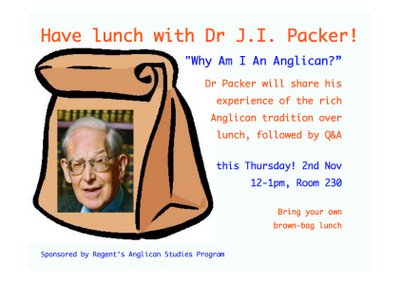
I am the Teachers Assistant ("TA") for Regent College's Anglican Studies Program. I got involved, not for the $10 an hour, but to work alongside people like Dr J.I. Packer and Professor Don Lewis, to learn more about the wider church heritage that I grew up in, but feel like I know little about, outside of Sydney Anglicanism.
So if you happen to be in Vancouver this week, please come along ...

I am the Teachers Assistant ("TA") for Regent College's Anglican Studies Program. I got involved, not for the $10 an hour, but to work alongside people like Dr J.I. Packer and Professor Don Lewis, to learn more about the wider church heritage that I grew up in, but feel like I know little about, outside of Sydney Anglicanism.
So if you happen to be in Vancouver this week, please come along ...
Sunday, October 08, 2006
Lest We Forget
My Old Testament Foundations course has me caught-up in the nation of Israel’s story as I am in the midst of reading the entire Old Testament in a 3-month window. I have been witnessing the Lord’s incredible and seemingly unforgettable acts of grace and deliverance as the Lord brings His people out of slavery in Egypt, splits the Red Sea to allow His people to escape, leads His people by a pillar of fire by night, provides for His people daily with manna from the heavens, and brings the walls of Jericho crashing down with a simple shout from His people - it’s an action-packed thriller!
But it doesn’t end there … David is chosen and brings Goliath down with a single stone. David is rescued and blessed with incredible military wins for Israel and is known as a man “who kept my commands and followed me with all his heart, doing only what was right in my eyes” (1 Kings 14:8). Solomon starts out so well too, building on his father David’s faithfulness, assumingly taking on board David’s instructions (2 Kings 2) and asking the Lord for wisdom so that he could lead Israel well. Solomon spends seven years building the Temple for the Lord to dwell in – a mighty international achievement that was not only very expensive to do, but required a huge amount of planning and resources to achieve. The result is amazing, and the Lord comes and dwells there. We then read of Solomon’s incredible achievements, his wealth and splendor and see that the Queen of Sheba comes and is astounded by Solomon’s achievements and longs to gain some of his wisdom. Through Solomon, Israel is abundantly blessed by God!
Reading the very next chapter (1 Kings 11), the unexpected twist in the story leapt out of the pages and slapped me in the face …
“As Solomon grew old, his wives turned his heart after other gods, and his heart was not fully devoted to the LORD his God, as the heart of David his father had been. He followed Ashtoreth the goddess of the Sidonians, and Molech the detestable god of the Ammonites.”
Solomon, this great man who God abundantly blessed, with all the wisdom in the world commits Israel’s sin, forgetting God and among others worshipped Molech – a ‘god’ who was associated with the detestable practice of child sacrifice. How can this be?
Solomon forgets, and a great man and nation fall a long way. The Lord instructed Israel’s Kings to not take many wives (Deut 17:17) and that marrying foreign women may lead the Israelites to worshipping foreign God’s. “Wise” Solomon forgot his father’s parting words, he forgot the law he was meant to meditate on and keep, and "discerning" Solomon forgot Israel’s history of forgetting their God.
For me, this is a humble reminder to not forget and to not be lead astray. Jesus’ words in the Sermon on the Mount (as one of many examples) about building wise foundations, not serving both God and money, loosing body parts that cause us to stumble and the wide easy road – help us remember.
May God bless you and keep as you go about remembering the Lord’s faithfulness, and get caught up in Israel’s story – your story – of a loving God pursuing His chosen people. That’s a story you can’t turn your back on!
But it doesn’t end there … David is chosen and brings Goliath down with a single stone. David is rescued and blessed with incredible military wins for Israel and is known as a man “who kept my commands and followed me with all his heart, doing only what was right in my eyes” (1 Kings 14:8). Solomon starts out so well too, building on his father David’s faithfulness, assumingly taking on board David’s instructions (2 Kings 2) and asking the Lord for wisdom so that he could lead Israel well. Solomon spends seven years building the Temple for the Lord to dwell in – a mighty international achievement that was not only very expensive to do, but required a huge amount of planning and resources to achieve. The result is amazing, and the Lord comes and dwells there. We then read of Solomon’s incredible achievements, his wealth and splendor and see that the Queen of Sheba comes and is astounded by Solomon’s achievements and longs to gain some of his wisdom. Through Solomon, Israel is abundantly blessed by God!
Reading the very next chapter (1 Kings 11), the unexpected twist in the story leapt out of the pages and slapped me in the face …
“As Solomon grew old, his wives turned his heart after other gods, and his heart was not fully devoted to the LORD his God, as the heart of David his father had been. He followed Ashtoreth the goddess of the Sidonians, and Molech the detestable god of the Ammonites.”
Solomon, this great man who God abundantly blessed, with all the wisdom in the world commits Israel’s sin, forgetting God and among others worshipped Molech – a ‘god’ who was associated with the detestable practice of child sacrifice. How can this be?
Solomon forgets, and a great man and nation fall a long way. The Lord instructed Israel’s Kings to not take many wives (Deut 17:17) and that marrying foreign women may lead the Israelites to worshipping foreign God’s. “Wise” Solomon forgot his father’s parting words, he forgot the law he was meant to meditate on and keep, and "discerning" Solomon forgot Israel’s history of forgetting their God.
For me, this is a humble reminder to not forget and to not be lead astray. Jesus’ words in the Sermon on the Mount (as one of many examples) about building wise foundations, not serving both God and money, loosing body parts that cause us to stumble and the wide easy road – help us remember.
May God bless you and keep as you go about remembering the Lord’s faithfulness, and get caught up in Israel’s story – your story – of a loving God pursuing His chosen people. That’s a story you can’t turn your back on!
Monday, June 26, 2006
A Life of Extremes in a World of Stability
I am beginning to fear that maybe Jesus really did mean what he said. I am a product of comfortable American thought and theology – product of the western world’s approach to Christianity. But the problem is, the Jesus I see in scripture is quite consistent in his teaching and that teaching consistently does not line up with my self-interest.
We see this played out most clearly when Jesus is confronted by the Rich Young Ruler. While Jesus told the rich young ruler to “sell all that he had,” this wasn’t the only thing said in the story. When the rich young ruler came to Jesus, he questioned Jesus, “what must I do to inherit eternal life?” This question is coming from someone who has it all. He is young, in his prime, full of vigor and life. He is rich with the house, job, and income that define his life and allow for good meals, wine, leisure. He is titled a “ruler” suggesting authority, power, respect. He has it all . . . and yet. And yet he comes to Jesus asking “what must I do to inherit eternal life.” This is not a question that comes out of satisfaction with one’s existence. It is a question that comes out of some quiet whisper, hint that there must be more than this – more than his current state of contentment.
Even at this point, Jesus does not respond with the famous and confronting “sell all that you have . . .” Instead, he tells the young man, “Obey the commandments . . .” With these words, the man’s context is further established. He is religiously educated, at least enough to know the commandments and to be aware of the basic concerns of the God of Israel. But still, the young man wants more clarification, suggesting what we later learn to be true, that he has been keeping them and it still isn’t satisfying him.
“Which ones?” the young man asks.
Jesus responds, “Do not murder (that one’s pretty easy). Do not commit adultery (more difficult, he probably thinks, but yeah, I’ve been good there). Do not give false testimony, honour your father and mother (tick and tick). Love your neighbour as yourself (Ooh, that one’s hard. But yes, I have honestly loved my neighbour as myself.)” The young man affirms that he has been faithful, “all these I have kept since my youth.” And Jesus does not challenge him on this affirmation of faithful living. The young man isn’t even a cynical, lapsed man of faith but a dedicated man who upholds the commandments and follows God’s laws, even the difficult ones! And yet, despite his devotion to God and his clear desire for God, as evident in his approaching Jesus, something is still missing.
Church attendance isn’t enough. Keeping God’s law isn’t enough. Approaching Jesus and seeking him isn’t even enough. Not to mention that money, power, and youth aren’t enough. Apparently, this young man is still hungry for more. Hopefully many of us are still hungry for more.
“One thing still you lack. Sell your possessions. Give the money to the poor. Come and follow me.”
Of course, this isn’t a call simply to a life of poverty. Anyone can take a vow of poverty and join a monastery in the Himalayas. And many have. No. This is a call to radical and transformative community. This is a call to an Acts 2:42-47 community. This is a call to living in real and uncomfortable ways with other believers. This is a call to an extreme life of self-sacrifice, and in that sacrifice, it is a call to finding a real, passionate life, filled with God’s Holy Spirit, truly alive with his grace and presence. This is a call to life redeemed. Life transformed. Life unending.
How can I say this? We must remember who Jesus was and what he was doing at the time. He was traveling all over Israel, with his friends and those committed to him, and he was preaching the Good News of God’s grace for his people and the world. We know from Luke 8 that some of those with Jesus helped support Jesus and the disciples through their own finances. We know that, while they were itinerant, they were often being invited into various homes to stay the night, share a meal. We also know that they celebrated important religious festivals together, as if they were family. This isn’t a call to poverty or homelessness. This is a call to a community where the rich young man would have to give up his self-determination and autonomy in order to be part of the larger community of Jesus’ followers. He had to give up his riches because they were what defined him. He also had to give up his riches because in Christ’s Kingdom there is neither rich nor poor, slave nor free, male and female.
A vow of poverty is merely a spiritual choice, part even of the sort of balance that the Buddha himself taught. Jesus never taught balance. He never taught an individual spiritual path. He never calls us into a personal faith. Jesus calls us to an extreme life. He calls us individually into a community of faith. He calls us to a life that he defines and directs as a part of his body, which is all who choose to follow him, all who believe and act on his call.
“Come and follow me . . .”
We see this played out most clearly when Jesus is confronted by the Rich Young Ruler. While Jesus told the rich young ruler to “sell all that he had,” this wasn’t the only thing said in the story. When the rich young ruler came to Jesus, he questioned Jesus, “what must I do to inherit eternal life?” This question is coming from someone who has it all. He is young, in his prime, full of vigor and life. He is rich with the house, job, and income that define his life and allow for good meals, wine, leisure. He is titled a “ruler” suggesting authority, power, respect. He has it all . . . and yet. And yet he comes to Jesus asking “what must I do to inherit eternal life.” This is not a question that comes out of satisfaction with one’s existence. It is a question that comes out of some quiet whisper, hint that there must be more than this – more than his current state of contentment.
Even at this point, Jesus does not respond with the famous and confronting “sell all that you have . . .” Instead, he tells the young man, “Obey the commandments . . .” With these words, the man’s context is further established. He is religiously educated, at least enough to know the commandments and to be aware of the basic concerns of the God of Israel. But still, the young man wants more clarification, suggesting what we later learn to be true, that he has been keeping them and it still isn’t satisfying him.
“Which ones?” the young man asks.
Jesus responds, “Do not murder (that one’s pretty easy). Do not commit adultery (more difficult, he probably thinks, but yeah, I’ve been good there). Do not give false testimony, honour your father and mother (tick and tick). Love your neighbour as yourself (Ooh, that one’s hard. But yes, I have honestly loved my neighbour as myself.)” The young man affirms that he has been faithful, “all these I have kept since my youth.” And Jesus does not challenge him on this affirmation of faithful living. The young man isn’t even a cynical, lapsed man of faith but a dedicated man who upholds the commandments and follows God’s laws, even the difficult ones! And yet, despite his devotion to God and his clear desire for God, as evident in his approaching Jesus, something is still missing.
Church attendance isn’t enough. Keeping God’s law isn’t enough. Approaching Jesus and seeking him isn’t even enough. Not to mention that money, power, and youth aren’t enough. Apparently, this young man is still hungry for more. Hopefully many of us are still hungry for more.
“One thing still you lack. Sell your possessions. Give the money to the poor. Come and follow me.”
Of course, this isn’t a call simply to a life of poverty. Anyone can take a vow of poverty and join a monastery in the Himalayas. And many have. No. This is a call to radical and transformative community. This is a call to an Acts 2:42-47 community. This is a call to living in real and uncomfortable ways with other believers. This is a call to an extreme life of self-sacrifice, and in that sacrifice, it is a call to finding a real, passionate life, filled with God’s Holy Spirit, truly alive with his grace and presence. This is a call to life redeemed. Life transformed. Life unending.
How can I say this? We must remember who Jesus was and what he was doing at the time. He was traveling all over Israel, with his friends and those committed to him, and he was preaching the Good News of God’s grace for his people and the world. We know from Luke 8 that some of those with Jesus helped support Jesus and the disciples through their own finances. We know that, while they were itinerant, they were often being invited into various homes to stay the night, share a meal. We also know that they celebrated important religious festivals together, as if they were family. This isn’t a call to poverty or homelessness. This is a call to a community where the rich young man would have to give up his self-determination and autonomy in order to be part of the larger community of Jesus’ followers. He had to give up his riches because they were what defined him. He also had to give up his riches because in Christ’s Kingdom there is neither rich nor poor, slave nor free, male and female.
A vow of poverty is merely a spiritual choice, part even of the sort of balance that the Buddha himself taught. Jesus never taught balance. He never taught an individual spiritual path. He never calls us into a personal faith. Jesus calls us to an extreme life. He calls us individually into a community of faith. He calls us to a life that he defines and directs as a part of his body, which is all who choose to follow him, all who believe and act on his call.
“Come and follow me . . .”
Saturday, May 20, 2006
Who do you want to be?
As a rule, I don’t read fashion mags. The reason is simple – after a few pages I am reminded of my larger than acceptable thighs, small breasts, bad skin, outdated clothes; and a deep craving – no, lust – for only five or six beauty products, a hair cut and colour, and a few new outfits wells up in my heart leading to a state of mild depression for at least 48 hours. Despite this general rule of self-preservation, I picked up a few that were lying around work recently. The effect was, as expected, an addictive personal dissatisfaction as the simple lies were whispered up from every page. “This can be you. With a bit of work. It’s worth the cash, after all look at the results. This can be you!”
But, do I want “this” to be me?
Do I want to be defined as “the girl with the good clothes?”
The one with the great hair?
The smart chick?
The sexy one?
The one with the great clothes, great hair, great body, and smart?”
“The woman of style and culture?”
Who do I want to be?
Moving overseas to a city that belongs to neither of us opens up the opportunity to start over. We are not tied to family and friends in a certain area. We know the neighbourhoods only through hearsay and glances. We are free to choose where we live and, in choosing, we assent to being defined by the lifestyle and attitudes of that place.
Do we choose to live in the stylish area with shops close by so our environmental footprint is smaller, good coffee, parks and beautiful spots of creation to enjoy and be in, surrounded by other people who are interested in books and God, who dress well and have good jobs and express concern for the environment and poverty? While sitting in a nice café. Over good coffee.
Do we choose to live in the transitional area with the homeless, the petty dealers, no safe parks to enjoy and few to be in, with a community of other students who are concerned for the homeless and the petty dealers, who have little and minister to “the least of these?” But walk home warily at night. Petty dealers aren’t afraid to mug and pick-pocket.
Do we make the choice to allow our convictions to shape our personalities and interests, the people we walk with, the conversations we have, and the work that we do. Or do we live our dream of . . . of convenience, of style, of safety? After all, living closer to college (in the stylish area) means a shorter (and safer) commute, which will give us more time for the friends we make (who, due to where we live and the way we spend our time as a result, will be more like us and easier to be friends with).
We know only a few people. We are not tied to certain personalities, but have the chance to re-create those aspects of ourselves that are boxed in, for whatever reason. No one remembers the silly or wise things we have done. We have no history. We have the chance to choose our direction. We’ve started down a path with Regent but that is only the beginning. There are many types of people at Regent and many paths to take. Don’t you see – this is the thing, the struggle that we all face in every decision from the biggest (job, housing, partner) to the smallest (clothes, food, time).
Who do we want to be?
Who do you want to be?
The choices you make shape who you are. The direction you take determines the way people see you and how you see yourself. You can only stay different from your choices for so long – given a few weeks or months, you look like everyone else who going in your direction; you become what you have chosen.
So, how do you choose? Conviction? Comfort? Style? Sacrifice?
Who do you want to be?
We only have a limited amount of money, a limited amount of time to spend each day. We only have a limited amount to spend on earth. And, as we see so often in Jesus’ teachings, how we spend ourselves dictates who we are. Each choice in one direction is a choice opposed to another direction. The time spent catching up with friends is time not spent teaching English to an immigrant. Time spent with your mates is time not spent with a lonely elderly man.
I know, it is important to enjoy life – spend time with friends – enjoy God’s gifts. It is truly important to do these things. But too often we choose enjoyment out of habit and inertia and fail to actually find joy (happiness and contentment are much easier) in the gifts of God we say we are enjoying.
Who do you want to be?
Audrey Hepburn, while a humanitarian later in life, is immortalised by popular culture for high cheekbones, big sunnies, and Breakfast At Tiffany’s. She is an icon of glamour, style, and beauty. Mother Theresa needed a few more facials in her lifetime but she is immortalised by popular culture for charity, generosity, and the Sisters of Mercy. She is an icon of grace, love, and Christ.
Choose your icon. Choose your destiny. Choose who you want to be.
But, do I want “this” to be me?
Do I want to be defined as “the girl with the good clothes?”
The one with the great hair?
The smart chick?
The sexy one?
The one with the great clothes, great hair, great body, and smart?”
“The woman of style and culture?”
Who do I want to be?
Moving overseas to a city that belongs to neither of us opens up the opportunity to start over. We are not tied to family and friends in a certain area. We know the neighbourhoods only through hearsay and glances. We are free to choose where we live and, in choosing, we assent to being defined by the lifestyle and attitudes of that place.
Do we choose to live in the stylish area with shops close by so our environmental footprint is smaller, good coffee, parks and beautiful spots of creation to enjoy and be in, surrounded by other people who are interested in books and God, who dress well and have good jobs and express concern for the environment and poverty? While sitting in a nice café. Over good coffee.
Do we choose to live in the transitional area with the homeless, the petty dealers, no safe parks to enjoy and few to be in, with a community of other students who are concerned for the homeless and the petty dealers, who have little and minister to “the least of these?” But walk home warily at night. Petty dealers aren’t afraid to mug and pick-pocket.
Do we make the choice to allow our convictions to shape our personalities and interests, the people we walk with, the conversations we have, and the work that we do. Or do we live our dream of . . . of convenience, of style, of safety? After all, living closer to college (in the stylish area) means a shorter (and safer) commute, which will give us more time for the friends we make (who, due to where we live and the way we spend our time as a result, will be more like us and easier to be friends with).
We know only a few people. We are not tied to certain personalities, but have the chance to re-create those aspects of ourselves that are boxed in, for whatever reason. No one remembers the silly or wise things we have done. We have no history. We have the chance to choose our direction. We’ve started down a path with Regent but that is only the beginning. There are many types of people at Regent and many paths to take. Don’t you see – this is the thing, the struggle that we all face in every decision from the biggest (job, housing, partner) to the smallest (clothes, food, time).
Who do we want to be?
Who do you want to be?
The choices you make shape who you are. The direction you take determines the way people see you and how you see yourself. You can only stay different from your choices for so long – given a few weeks or months, you look like everyone else who going in your direction; you become what you have chosen.
So, how do you choose? Conviction? Comfort? Style? Sacrifice?
Who do you want to be?
We only have a limited amount of money, a limited amount of time to spend each day. We only have a limited amount to spend on earth. And, as we see so often in Jesus’ teachings, how we spend ourselves dictates who we are. Each choice in one direction is a choice opposed to another direction. The time spent catching up with friends is time not spent teaching English to an immigrant. Time spent with your mates is time not spent with a lonely elderly man.
I know, it is important to enjoy life – spend time with friends – enjoy God’s gifts. It is truly important to do these things. But too often we choose enjoyment out of habit and inertia and fail to actually find joy (happiness and contentment are much easier) in the gifts of God we say we are enjoying.
Who do you want to be?
Audrey Hepburn, while a humanitarian later in life, is immortalised by popular culture for high cheekbones, big sunnies, and Breakfast At Tiffany’s. She is an icon of glamour, style, and beauty. Mother Theresa needed a few more facials in her lifetime but she is immortalised by popular culture for charity, generosity, and the Sisters of Mercy. She is an icon of grace, love, and Christ.
Choose your icon. Choose your destiny. Choose who you want to be.
Subscribe to:
Posts (Atom)


 Posts
Posts


