Wednesday, March 21, 2007

Classic!

Entertainment options in cold and wet Vancouver are somewhat limited on a student budget (especially when you are giving up wasting time on the iMac for lent).

However the Vancouver Public Library is stocked with a bunch of ‘classic’ DVD’s which are free to borrow! The Library also tends to hold out and buy the ultimate DVD version with all the special features. Some include recent interviews from cast and crew about the impact of a classic movie (e.g. M.A.S.H.).


So far, we have enjoyed watching several movies we hadn’t seen before:
>Alfred Hitchcock’s Psycho – 4 Oscar Nominations
>M.A.S.H. (The Original Movie) - 1 Oscar
>The Godfather – Parts 1,2 & 3 – 9 Oscars
>Butch Cassidy and the Sundance Kid – 4 Oscars
>Lawrence of Arabia – 7 Oscars
>2001 A Space Odyssey - 1 Oscar
>Patton – 8 Oscars
>My Left Foot - 2 Oscars (I’m not sure it’s a classic (yet), but certainly a great story)


On the agenda:
>Ben Hur
>Gone with the Wind


Any other Classics worth looking out for?

Saturday, March 17, 2007

'touching down' on biblical economics

Regent’s Christian Thought & Culture course has been great! Over two terms we ‘touch-down’ briefly to see how Christian thought has developed and shaped cultures from the early church fathers right up to the 21st Century. We have ‘touched-down’ on: the spiritual practices of the church fathers; Jesus’ transforming message being met by the Greco-Roman world, the spread of Christianity throughout the world over time, the Christian influence on the arts, the good and the bad of the Reformation, the influence of philosophical movements and in the last few weeks, in the modern era, a Christian response to globalisation, ecology in the bible and an examination of tricky biblical text concerning models of marriage.

That isn’t half of it! By nature, this course touches-down on too many issues, which can be frustrating, as I want so much more on certain topics. But, our Professors know this and create the assessment around the frustration. We get to write our own research questions and we are set an additional reading assignment where we get to choose our own adventure and read 50 pages from 8 different sources from a wonderful reading list.

This week I have been reading Rich Christians in an Age of Hunger. First published in 1977, this book caused quite a stir and was embraced and rebuked accordingly. It’s now in it’s 4th edition and it is still stirring and being rebuked! In a nutshell, Ron Sider provides a biblical understanding of God’s Economy and how it can affects today’s economy and Christian & Church economic actions. For me this book brings together several areas of interest including affluenza, fair trade, poverty, simpler lifestyles and (all too briefly) environmental concerns based on economic activity.

In ending a chapter on Thinking Biblically about Property and Possessions, Snider writes:
In a consumer society that increasingly measures a person’s worth and importance by the amount of his or her material possessions, biblical Christians will reject materialism without falling into asceticism. They will delight in the splendor of the material world but not forget that things cannot ultimately satisfy. They will enjoy the good earth and celebrate its abundance without neglecting sacrificial sharing with the needy. They will distinguish between necessities and luxuries. They will enjoy possessions while recognizing their seductive danger. When forced to choose between Jesus and possessions, they will gladly forsake the ring for the Beloved.
A read worth being stirred by!

[Since posting, I have added a few more thoughts/quotes see: Comments]

Thursday, February 22, 2007

What we are giving up for Lent …

[This blog title sounds so pious. You will have to take my word for it, but that’s really not how I feel about it at all …]

Lent n. (in the Christian religion) an annual season of fasting and penitence in preparation for Easter, beginning on Ash Wednesday and lasting 40 weekdays to Easter, observed by Roman Catholic, Anglican, and certain other churches.

For the last three years Jessica and I have given up ‘sweets and alcohol’ for the season of Lent. So for 40 days, with a break on Sunday, we drank no beer or wine (one year Sprits were ok!) and had no chocolate, ice cream, biscuits or even birthday cake when our colleagues were celebrating. Well … maybe I limited myself to one small glass of red with the Manly boyz on a Monday night at Ash’s, but I was mostly good!

Most of the Aussie readers of this blog don’t really get this Lent thing because we haven’t grown-up with it. My take on it is, that by giving something up that you really will miss, when you think/want/need that thing, instead of satisfying yourself with it, you turn your heart and mind to the Lord in prayer and be satisfied in Him instead. Lent is meant to help focus us as we journey towards remembering the Easter tragedy of our Lord’s death and then the celebration of our Lord’s resurrection, at which point gluttony is all ok (as we celebrate)!

Personally, I have had mixed results with the discipline of Lent. Sometimes I focus more on the Lord, often not. Is that because I haven’t developed this discipline by growing-up spending the year moving through the church calendar? Or is it because I don’t have much of a sweet tooth and I can do without a drink if I know that a bottle of red will be cracked each Sunday? Maybe I need to give up something that I need and/or want more. My brother-in-law decided that that giving up chastity for Lent was the answer …

So, this year, instead of sweets and alcohol, we are both giving-up wasting time on the computer. It is amazing how much time and attention computers can absorb from our days – what did we do with our time before the internet and digital photography? ‘Wasting time’ is a contentious phrase, as it has been defined for the purposes of Lent as no smh.com.au, web-surfing, blog reading or iPhoto. Email is ok, and writing the odd blog will pass too (maybe you think this is a waste of time?), but we think it could be tough where the time wasting line is to be drawn, so we are going to ask each other permission on what we can and cannot do on the computer. Keep in mind, that we still don’t have a TV, and that it’s wet, dark and cold outside, so we tend to waste our time in front of our 20inch iMac.

The challenge will be to turn our attention to the Lord and maybe we will find some better uses of our time as we journey with Jesus towards Jerusalem. We’ll have to let you know …

Thursday, February 15, 2007

Vancouver can be a challenging place to live!

It's often cold, wet and dark and we have had a lot of snow in the city this Winter. Having the right kind of clothes can be a big help, so we are really grateful for Jessica's Mom's creative talents in crocheting us some new winter woolies that not only are keeping us warm, but we think look pretty good as well!


Thank you Linda!

Wednesday, January 31, 2007

What I’m Learning at Regent

Sometimes it felt like a chorus. The same concerned warning coming from all sides – church, friends, even students. I understood their concern and even, deep down, shared it.

Don’t just learn about God . . .

The great danger in studying theology, it seems, is the tendency to examine, measure, and turn God over and inside out until he is fixed in a formulated phrase, sprawling on a pin. But no one thought to warn me about the other possibility, one I myself could hardly have expected.

No one warned me that I might have to fight to maintain my composure in a 3-hour lecture. No one thought to mention that, if you give your mind and heart over to the study of the intersection of the Timeless One with time, he might be more than you can bear. No one even suggested that such an endeavour could possibly result in the heart and the mind being overwhelmed and stuck dumb with wonder at the Holy One of Israel.

No one warned me about Jesus.

That may sound surprising considering I’ve literally grown up in my faith, in the same way I’ve grown up in my own skin. But the great gift of studying is that, the more I learn about Jesus, the more I study (or am forced to study for an exam) just what he was on about, the more captivating he becomes.

We get used to saying the great creedal statements, “the only begotten son of the father; God from God, light from light, true God of true God . . . “ and we know that we know these things, these great Truths . . . but to stand in the presence of the One who fashioned the ever expanding universe with just a word, the One who causes mountains to tremble, kingdoms to rise and fall, the great and terrible Holy One, often seems somewhat distant from our crafted creeds, clappy choruses and even our careful exegesis.

But every Wednesday I get to go to a New Testament survey course and I am told stories I have heard my entire life. I am told stories I have told to others. I am told stories that I have never heard in this way before. Every week, it seems as though I become a Christian all over again as I sit in awe, overwhelmed by excitement and passion at the great and terrible Jesus. I sit in wonder as my heart whispers, trembling, “truly, this man is the Son of God.”

Such a statement is probably too simple a thing for most of you to expect us to learn at “bible college.” Shouldn’t we have already known this? Yes. And No. The Incarnation, that the God of the cosmos became a human so that we might be restored as His image bearers and be indwelled by that very God, is something we only ever half-guess, only ever half-understand.

This is why my greatest struggle is to not burst into tears two hours in to a three-hour lecture. I am surprised and amazed again by Jesus, the Holy One, who is filled with compassion for us, for me. It is far too great and glorious a thing for my feeble mind to grasp. And it is truly wonderful.

Sunday, January 21, 2007

Video Update #1

It's time to integrate

integrate v. 1 combine (parts) into a whole

Our brief time at Regent College has taught us the importance of adapting a holistic approach to life. This means abandoning the unhelpful distinction between our ‘Christian’ and our ‘other’ lives, and moving to a place where study is worship, worship is play, and play is work. This is why at Regent you will find courses on Christianity and Capitalism, Jesus in Literature and Everyday (not just Sunday) Spirituality. This ‘summer’ (July/August) courses won’t just be offered in a lecture theatre, but the teaching and learning will be integrated into Vancouver’s poor Downtown Eastside and on a sail boat amongst Vancouver’s Gulf Islands. The integration reaches beyond the classroom to Regents’ art gallery, kitchen, and the new, environmentally friendly wind tower that is about to be unveiled (more to blog on this!). Of course, when you study with people from six continents and a range of church backgrounds a picture of an integrated church emerges, and this further shapes and challenges the idea of living holistically as a Christian.

We have had several emails from people asking about what our experience here has been like. While we were active on our blog toward the end of last year, it focused primarily on one aspect of our life in Vancouver, rather than sharing about the rain, slush, snow, wind, and ice that make up the rest of our lives (or maybe it only seems that way in January).

So for those who are keen to share in our journey a little more, we are aiming to blog more “holistically.” We will continue to write seriously, but also to share with you more of the people, places, ponderings, pictures and possibilities that we experience here in Vancouver. For a fully holistic experience to be possible, we of course need you who have shared in and helped shape our whole journey to be a part of it, so please add your comments.

We don’t yet think that we have even fully grasped (or lived out) what it means to live wholly in Christ. We hope this blog will be a start, and that the process of learning to live holistically will bring honour and glory to our Lord as we journey.

Friday, December 08, 2006

An Open Letter to the Standing Committee of the Sydney Anglican Diocese

We have been sent an email containing an open letter addressed to the Standing Committee of the Sydney Anglican Diocese. The letter was written by Rev Dr Keith Mascord who will soon take up a role as the National Chaplain at Mission Australia.
We do not know Keith personally.

As the letter is an open letter, can I encourage you to read it! The letter is written in a good spirit addressing some specific and some more general concerns about the nature of the Sydney Anglican Diocese.

Keith has encouraged feedback to this letter, both affirming and also disagreeing with his thoughts, which are representative not only of himself but generally from a council of people he represents. Keith's cover email indicates that these responses will also be passed onto Standing Committee. Can I encourage you firstly to email your feedback to Keith (his email is in the letter), but also consider adding those thoughts to this blog so that other readers can see and perhaps interact with your response (do so anonymously if you would prefer).

Please also feel free to email others the link to the letter or to this blog, so that they can join the discussion.

I would like to affirm the spirit this letter was written in by encouraging you to pray as Keith has suggested in his covering email.
"Regardless of whether you agree or disagree with the sentiments of
the letter, please pray that good will come out of this, and that
involved would act in loving, humble and non-defensive ways."


Read Keith's Open Letter to the Standing Committee


FYI - "The Standing Committee is made up of approximately 60 people (either ex-officio or elected) who meet monthly to exercise many of the powers of the Synod when it is not meeting." View Source

Wednesday, December 06, 2006

Cultural Experience 101

You may have seen this in the Winter Olympics?

You probably had the thought, "those crazy Canadanians" ...

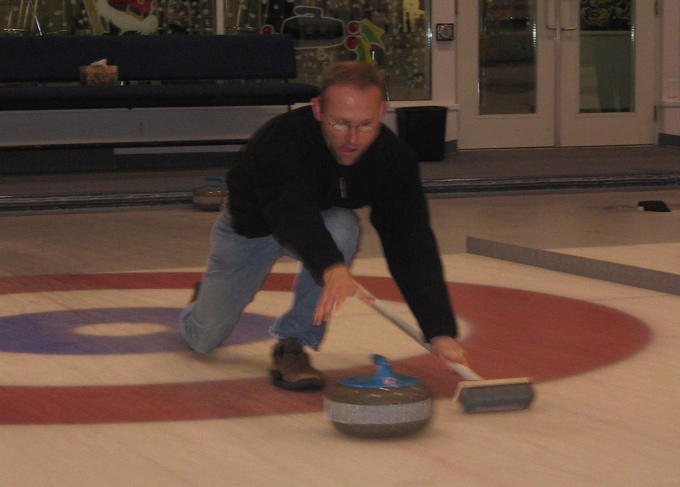
If you crossed a 10 pin bowling centre, on ice, with lawn bowls (but definetly no bare feet), you probably wouldn't have come up with Curling, but that's what you get anyway!

Our Regent community group had a great time, although our form at times was questionable ... it was clear that the other groups were taking their curling much more seriously than we were!

The winners were the 3 Aussies and a Yank who convincingly beat the 3 Canadians (shame ...), the Yank and the Irish.

And yes, sweeping the ice does do something ...

See Jess, Nerida & I on YouTube!

Thursday, November 30, 2006

How Much Redemption Can We Stand? (3 of 3)

It is fair to say, I think, that we in the church “are not in the business of legitimising the fallenness of things, but of ushering in the kingdom of God” (or we should be)! What does this mean for our reading of scripture? What we think scripture says should shape how we live and so how we read scripture is very important. We need to employ a hermeneutic that requires us to consider the overall direction of the text’s energy and intent. We need to look for the highest ethic that scripture is pushing toward, rather than legal concessions for our weakness or legislation to keep society (and the church) from getting worse than it already is, in determining what is the best and most ethical way to behave. This distinction between ethics and law is important. Law is never the highest aspiration of a society. Thus, upholding law is not the highest aspiration of the Christian, our highest aspiration is to push beyond the minimum the law requires to the maximum embodiment of love of God and love for neighbour. And this must underlie all our reading of scripture.

So, why am I harping on about this? Most of my observations are probably obvious. Yet, when we begin to consider scripture in this light, we find that scripture may be on a different trajectory than the one we are currently on. What are the implications of this hermeneutic that is based on the trajectory of scripture for “women’s issues” in the church? Is there perhaps, like with slavery, a cultural blinding that has kept us reading texts in a certain manner, not because it is the best way to understand the overall passage and message of the Bible but because this reading is the only one our cultural and historical lenses would allow?

What are the implications of this hermeneutic for our attitudes toward the poor and wealth accumulation? The trajectory of scripture on this issue is a bit different from slavery. Rather than ameliorating the condemnation of those who oppress the orphan, the widow, the alien, and the poor, scripture consistently, loudly and forcefully pursues a message of liberation for the oppressed, roundly condemning those who do not care for the poor and dispossessed. When we think about it, this consistent condemnation is also a very redemptive direction. It is the direction of generosity. It is the direction of loving others as ourselves. What is it to consider the law, the prophets, the teachings of Jesus in this light rather than to write them off as somehow not quite as applicable to us today?

The great irony is, we seem to continue reading scripture from our place of privilege, so sure of what it says that we may very well be missing the heart of the message. How much redemption can we stand as a people? Can we stand to have our societal structures, our churches, our economics redeemed? Or are we content to stop with our individual souls and let it go at that? Are we to be in the business of legitimising the fallenness of things? Or are we to partner with God in bringing about his kingdom?