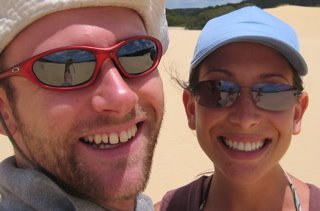
We prepared and celebrated our first thanksgiving meal in our own place this year, and were blessed to be joined by a good friend, Helen, from Vancouver. As it turned out, the thanksgiving meal was the first meal cooked in our new kitchen, we moved into our new house a few days earlier.
As this was our first holiday meal in our home, we began two traditions that our family will carry forward. The first, holiday meals as a multi-course dinner that is enjoyed and savored slowly, allowing much opportunity for table-talk as family and friends gather, and pairing each course with an appropriate bottle of wine. This tradition started at Christmas 2008, where Jess cooked her first Christmas dinner at her folks place, a six course meal that was deemed the best Christmas meal ever by her younger brother.
The thanksgiving five course meal started with an appertizer of pesto and cranberry crostini, followed by a pumpkin soup with blue-cheese croƻtons. The main course was anything but traditional, a venison meatloaf served on a bed of sweet potato mash - the deer was shot locally by Craig who finished putting in our kitchen cabinets the day before. A cheese platter followed, which included a traditional touch of cranberry sauce served on a cracker with blue cheese. By the end of the fourth course, we were quite full, so the fifth and final dessert course, a chocolate ice cream covered with a dark-chocolate cranberry sauce and served with a tawny port, was enjoyed later on the couch while watching NCIS...
The second tradition that we began, was to take the time to express our thankfulness - to each other and also to our good and giving Lord. So, for each course that was served, everyone at the table shared something they were thankful for. This year we had much to be thankful for - a wonderful new home to live in, as we also celebrated our sixth wedding anniversary on thanksgiving weekend we were thankful for eachother, plus the many opportunities that we are privileged to have - to be able to study at places like Regent College and Notre Dame, and to be able to travel back to Sydney for Christmas and a wedding this year (see you all soon!).
The +giving side we will have to work on for next year... we have been a little self-consumed of late by our own need to settle into this new town and house. In being thankful for our new house, we were also prayerful that our house would be a place that gave warm hospitality. With Helen as our first house guest, we are off to a good start...
Monday, November 30, 2009
Thursday, September 17, 2009
photo shoot - Tenth Church @ Kits
Some of my photos from the shoot that I mentioned in my previous post are being used at tenth.ca - cool!
Monday, August 03, 2009
insight into Vancouver mindset
Last week, I was asked to do a photo shoot with my friend KC Flynn for Tenth Alliance Church as they are about to launch a satellite service in Kitslano. We got some pictures of Kitslano Secondary School where the church will be meeting, and KC came across this poster in one of the hallways...

I think this is a fascinating insight into the mindset of Vancouverites. It is one thing for people to have this opinion, it is another to put it on a poster in the hallway of a public school and not have it torn down or a protest erupt.

I think this is a fascinating insight into the mindset of Vancouverites. It is one thing for people to have this opinion, it is another to put it on a poster in the hallway of a public school and not have it torn down or a protest erupt.
Thursday, July 30, 2009
goodbye Whistler?
I first came to Whistler in January 2002. Four months later, I had skied 67 days, spent many late and enjoyable nights working at Whistler Village Sports, discovered an amazing burger place (Splitz grill) and had had a much-needed break. I got to enjoy these spectacular mountains, which rise whopping 5000 feet above the valley floor, with friends old (TK, Adam, Scott, Pete LaF, Jake, Mum & Dad) and new (Chris, Shara & Jen). After 67 days, there was still a lot of skiing on these hills to be done…
So I confess… coming to study in Vancouver always had an ulterior motive. Jess and I have been blessed to be able to enjoy three more ski seasons and two summer visits. Each season we booked a 3-day trip (twice on bargain time-share trial deals!) and also did a bunch of day-trips with the crew from Regent, the Neridas, Ken & Julie, Matt & Chris and AY.
While Whistler is known for its winter activities, the two summer visits that Jess and I enjoyed hiking and biking were incredible too. We just got back from a farewell stay, where we hiked the recently built alpine trails along Blackcomb mountain. The weather was warm, the wildflowers blooming and the creeks running wild.
We experienced the Peak-2-Peak Gondola for the first time, which transports skiers from the peaks of Whistler to Blackcomb mountain in 11 minutes. While I don’t think its necessary to ski both of these huge mountains on a single day, this gondola is a truly amazing engineering feat. At its tallest point, you are 436 meters high and the unsuspended cable length is 3km (1.88 miles) long. If the gondola breaks down, I have no idea how they would be able to rescue people from such heights!
Whistler is gearing up to host some of the events for the Vancouver 2010 Olympics, so we checked out the impressive new sliding centre (perhaps Whistlers white elephant after the games?), which will host the bobsled and luge events.
So for now, goodbye to wonderful Whistler… and hello again when we will tune in come February 12!
Monday, July 27, 2009
SOLD!
Another BIG thank you, to our friend and Realtor, Elmar Klukas, for the many showings, his counsel and patience (with us) and his professional manner in pushing a complex sale through...
The next step, Indiana via U-Haul, we don't walk alone...
We celebrated the sale in style, Jess cooked a 5 course dinner (including some local lamb - yes Mum I am getting some meat!)) and we cracked a magnificent 2002 St. Hugo Cab Sav (bottle #77907 to be precise)...
Sunday, July 19, 2009
#2/2 – Jesus saves; the church?
The Sydney Anglican Diocese lost $100,000,000.00 in the stock-market slump brought on by the Global Financial Crisis (GFC), [read some news and opinions about it in my #1/2 post.] The $100 million loss was partly caused by an investing strategy known as “gearing,” where the investor borrows money to then invest. If the market goes up, gearing accelerates the gains, but if the market goes down – as it did in the GFC – then the losses are magnified. Here are three of my reflections on the Sydney Anglican Dioceses investment woes…
First, a fairly rudimentary understanding of the biblical text should result in the reader feeling uneasy with a ready embrace of debt, which we see in Western economies today – from households to firms, governments and perhaps even churches. While I won’t argue for a water-tight hermeneutical understanding linking biblical texts about debt to modern investment practises, it is worth hearing the biblical text’s aversion towards debt. In Lev.25, the Year of Jubilee is prescribed to ensure indebted families would be able to have their debts forgiven and retain ownership of their land, resulting in their ongoing economic and social inclusion. Deut. 15 speaks of removing debt from the life of Israel and foresees a situation where Israel borrows money from no nation. Prov. 22:26-27 warns about entering into debt when the cost of such debt may be losing life’s essentials (in this case, a bed to sleep in). Jesus uses canceled financial debts as examples of the Kingdom of God in his parables (Lk.7 & Mt.18). The aversion to debt expressed in the Bible is also expressed in the lives of saints throughout the majority of Christian tradition. It was only in 1822 that the Catholic Church relaxed its condemnation on charging interest on a loan. Considering the aversion the Bible has towards debt, doesn’t the question have to be asked why a church denomination would willfully go into debt without any necessity to do so?
Second, the majority of written material I read from the hands of members and leaders of the Sydney Anglican church had no biblical or theological reflection on the gearing strategy (using debt to accelerate gain). Instead, the articles were responding to media criticism, informing parish members about the consequences of the $100 million loss, explaining away the loss as the fall-out of contemporary investment strategies, and some were looking for heads to roll. The lack of biblical and theological critique on the $100 million exposes a way of thinking that separates issues of the church from issues of the marketplace; traditionally this has been termed the “sacred” and the “secular” divide. This form of dualism manifests itself in much Sunday teaching and preaching, where the nitty-gritty practicalities of the biblical text are spiritualised away, beyond any connection to everyday actions and decisions that parishioners face on Monday morning. If the scholarly leaders of the denomination don’t set an example of how to integrate biblical and theological understandings with everyday practicalities like investments, then the pew sitters will be left stumbling in the dark as they try to live holistic Christian lives. Or worse, they will be sadly ignorant that the good news of the redeeming gospel may, in-fact, have implications for all areas of life.
Third, how can a church be salt and light to a city if it acts in exactly the same way as the city? The reactions of journalists and letter writers, as they express opinions on the 100-million-dollar loss, is that the Anglican church has no credibility: the church has acted hypocritically and the church even ignored its own good book. The Sydney Anglican diocese has demonstrated that it has a disconnect between the means (debt-dependent gearing) it chooses to employ and its ends (the preaching of the Gospel and bringing people to faith in the God of the Bible). They have seemingly adopted the attitude that as long as the market keeps going up, the means justify the ends. But do the ends justify the means?
In Resident Aliens: Life in the Christian Colony, Hauerwas and Willimon argue that for missional activity by the church to be effective, the church must not accommodate itself to the ways of the world, but instead the church must behave like the church. Perhaps, Sydney Anglicans need to ask themselves Hauerwas and Willimon’s question:
First, a fairly rudimentary understanding of the biblical text should result in the reader feeling uneasy with a ready embrace of debt, which we see in Western economies today – from households to firms, governments and perhaps even churches. While I won’t argue for a water-tight hermeneutical understanding linking biblical texts about debt to modern investment practises, it is worth hearing the biblical text’s aversion towards debt. In Lev.25, the Year of Jubilee is prescribed to ensure indebted families would be able to have their debts forgiven and retain ownership of their land, resulting in their ongoing economic and social inclusion. Deut. 15 speaks of removing debt from the life of Israel and foresees a situation where Israel borrows money from no nation. Prov. 22:26-27 warns about entering into debt when the cost of such debt may be losing life’s essentials (in this case, a bed to sleep in). Jesus uses canceled financial debts as examples of the Kingdom of God in his parables (Lk.7 & Mt.18). The aversion to debt expressed in the Bible is also expressed in the lives of saints throughout the majority of Christian tradition. It was only in 1822 that the Catholic Church relaxed its condemnation on charging interest on a loan. Considering the aversion the Bible has towards debt, doesn’t the question have to be asked why a church denomination would willfully go into debt without any necessity to do so?
Second, the majority of written material I read from the hands of members and leaders of the Sydney Anglican church had no biblical or theological reflection on the gearing strategy (using debt to accelerate gain). Instead, the articles were responding to media criticism, informing parish members about the consequences of the $100 million loss, explaining away the loss as the fall-out of contemporary investment strategies, and some were looking for heads to roll. The lack of biblical and theological critique on the $100 million exposes a way of thinking that separates issues of the church from issues of the marketplace; traditionally this has been termed the “sacred” and the “secular” divide. This form of dualism manifests itself in much Sunday teaching and preaching, where the nitty-gritty practicalities of the biblical text are spiritualised away, beyond any connection to everyday actions and decisions that parishioners face on Monday morning. If the scholarly leaders of the denomination don’t set an example of how to integrate biblical and theological understandings with everyday practicalities like investments, then the pew sitters will be left stumbling in the dark as they try to live holistic Christian lives. Or worse, they will be sadly ignorant that the good news of the redeeming gospel may, in-fact, have implications for all areas of life.
Third, how can a church be salt and light to a city if it acts in exactly the same way as the city? The reactions of journalists and letter writers, as they express opinions on the 100-million-dollar loss, is that the Anglican church has no credibility: the church has acted hypocritically and the church even ignored its own good book. The Sydney Anglican diocese has demonstrated that it has a disconnect between the means (debt-dependent gearing) it chooses to employ and its ends (the preaching of the Gospel and bringing people to faith in the God of the Bible). They have seemingly adopted the attitude that as long as the market keeps going up, the means justify the ends. But do the ends justify the means?
In Resident Aliens: Life in the Christian Colony, Hauerwas and Willimon argue that for missional activity by the church to be effective, the church must not accommodate itself to the ways of the world, but instead the church must behave like the church. Perhaps, Sydney Anglicans need to ask themselves Hauerwas and Willimon’s question:
“At every turn the church must ask itself: Does it really make any difference, in our life together, in what we do (in this case, in how we invest), that in Jesus Christ God is reconciling the world to himself?”
Tuesday, June 23, 2009
South from Alaska
After our time in California in May, we decided to take the scenic route home and in so doing celebrate our graduation from Regent College and start to bring a close to our time in Vancouver.
[View the full-screen slideshow]
A special thank you to Steve & Linda, Clyde & Sue, Grandma, and Steve & Annemaree for your unexpected and generous graduation gifts which helped make the scenic-route home possible...
Saturday, June 13, 2009
#1/2 - Jesus saves; the church?
It’s been quite a week in the newspapers and the blogosphere for “the world's richest and largest Anglican diocese.” The Sydney Diocese lost $100,000,000.00 due to the downfall of its geared investment strategy, which has suffered at the hands of the global financial crisis.
Post #1/2 – I will present a sampling of what I found online (note, my sampling and mild-reflections are not intended to be neutral)
Post #2/2 – I will present some of my reflections regarding what Jesus was on about and what the church is doing in response
The online sampling:
In a classic SMH headline “Millions wiped out by church gambles,” SMH reporter Damien Murphy tries to sketch out some details of the Sydney Anglican dioceses losses. Murphy cites comments (aimed at the dioceses leadership): "Nobody's taking responsibility for this. In other organizations heads would roll"
A 2UE radio interview (embedded in the SMH article) of SMH business columnist Ian Verrender has the following reflections on the church's position: “Jesus saves, the church invests;” the church has committed “the cardinal sin of investing;” the church's “boom strategy” is likened to “investment becomes gambling;” the church's investment strategy is lumped-in with the likes of the high-profile failure of the Storm Financial group; and Sydney Anglicans are accused of “not taking notice of the bible despite their bible-bashing beliefs.”
In a letter to members of the Sydney Anglican church, Archbishop Jensen admits that “as the whole market fell, this (gearing) strategy also accentuated our losses” resulting in a 50% loss of capital and distribution income.
In a blog post “SMH at it again,” Rev. Andrew Katay steers the issue of investment strategies towards (what seems to be a common response by Sydney Anglicans) attacking what the SMH writes rather than addressing the real issues behind the particular article. Don’t get me wrong, journalistic bias is an important issue and should be discussed, but not at the cost of ignoring the real issues. John Sandeman comments, with helpful insight, on the media’s processes and fact checking capabilities.
Richard Cho (a former Financial planner, now OMF missionary to Thailand) redeems the post (via the comments) by addressing the real issue at hand. Cho asks a really important question (that no one else seems to be asking): “I don’t think it is a question of the strategy working for a while and then not working or of hindsight. The question is, what kind of investor is the diocese?”
Bishop Forsyth’s personal reflection "Eye of media storm" deals with the investment (and related media) issue this week: “I see no problem with putting the money God has given us wisely into investments to increase its value. And even adding to that sum through prudent borrowing and reinvestment. At least not in a moral or theological sense.” Forsyth’s views are consistent with the investment approach employed by the SDS board he sits on.
While looking at the homepage of sydneyanglicans.net, I found a reflection by the Archbishop’s brother addressing the question, are “Christians at risk of affluenza?” My citing of this reflection is out of context to be sure, but it is worth considering Jensen's thoughts in the context of an investment strategy that took on immense risk in borrowing to gain. Jensen says “For the Christian, affluence is the danger of being “choked by the cares and riches and pleasures of life” (Luke 8:14). Little by little, the seed of eternal life, the word of God, is choked out of our lives. The sacrifice that our Saviour made for us, no longer controls our spending patterns or our hearts’ desires.” Does "the sacrifice that our Saviour made for us, no longer control" our investment patterns?
Finally, the good ol’ SMH letters from the day after the SMH article was printed… These bring together an interesting conglomerate of opinions on the issue... “why are such profitable institutions tax-free?” “Can we assume that Anglican Archbishop Peter Jensen will now take a 50 per cent salary cut in order to help those less fortunate?” “Ah, the House of Jensen crippled by a bad gambling habit. God works in mysterious ways, doesn't she?” Plus, Rev. Nigel Fortescue’s expressed the desire that “Working together to serve Jesus might be better than embedding division.” Fortescue also names and shames a dissenting voice (who is quoted in the SMH article) as looking for scapegoats. Perhaps this dissenter is seeking accountability from the diocese in a disastrous financial situation?
Post #1/2 – I will present a sampling of what I found online (note, my sampling and mild-reflections are not intended to be neutral)
Post #2/2 – I will present some of my reflections regarding what Jesus was on about and what the church is doing in response
The online sampling:
In a classic SMH headline “Millions wiped out by church gambles,” SMH reporter Damien Murphy tries to sketch out some details of the Sydney Anglican dioceses losses. Murphy cites comments (aimed at the dioceses leadership): "Nobody's taking responsibility for this. In other organizations heads would roll"
A 2UE radio interview (embedded in the SMH article) of SMH business columnist Ian Verrender has the following reflections on the church's position: “Jesus saves, the church invests;” the church has committed “the cardinal sin of investing;” the church's “boom strategy” is likened to “investment becomes gambling;” the church's investment strategy is lumped-in with the likes of the high-profile failure of the Storm Financial group; and Sydney Anglicans are accused of “not taking notice of the bible despite their bible-bashing beliefs.”
In a letter to members of the Sydney Anglican church, Archbishop Jensen admits that “as the whole market fell, this (gearing) strategy also accentuated our losses” resulting in a 50% loss of capital and distribution income.
In a blog post “SMH at it again,” Rev. Andrew Katay steers the issue of investment strategies towards (what seems to be a common response by Sydney Anglicans) attacking what the SMH writes rather than addressing the real issues behind the particular article. Don’t get me wrong, journalistic bias is an important issue and should be discussed, but not at the cost of ignoring the real issues. John Sandeman comments, with helpful insight, on the media’s processes and fact checking capabilities.
Richard Cho (a former Financial planner, now OMF missionary to Thailand) redeems the post (via the comments) by addressing the real issue at hand. Cho asks a really important question (that no one else seems to be asking): “I don’t think it is a question of the strategy working for a while and then not working or of hindsight. The question is, what kind of investor is the diocese?”
Bishop Forsyth’s personal reflection "Eye of media storm" deals with the investment (and related media) issue this week: “I see no problem with putting the money God has given us wisely into investments to increase its value. And even adding to that sum through prudent borrowing and reinvestment. At least not in a moral or theological sense.” Forsyth’s views are consistent with the investment approach employed by the SDS board he sits on.
While looking at the homepage of sydneyanglicans.net, I found a reflection by the Archbishop’s brother addressing the question, are “Christians at risk of affluenza?” My citing of this reflection is out of context to be sure, but it is worth considering Jensen's thoughts in the context of an investment strategy that took on immense risk in borrowing to gain. Jensen says “For the Christian, affluence is the danger of being “choked by the cares and riches and pleasures of life” (Luke 8:14). Little by little, the seed of eternal life, the word of God, is choked out of our lives. The sacrifice that our Saviour made for us, no longer controls our spending patterns or our hearts’ desires.” Does "the sacrifice that our Saviour made for us, no longer control" our investment patterns?
Finally, the good ol’ SMH letters from the day after the SMH article was printed… These bring together an interesting conglomerate of opinions on the issue... “why are such profitable institutions tax-free?” “Can we assume that Anglican Archbishop Peter Jensen will now take a 50 per cent salary cut in order to help those less fortunate?” “Ah, the House of Jensen crippled by a bad gambling habit. God works in mysterious ways, doesn't she?” Plus, Rev. Nigel Fortescue’s expressed the desire that “Working together to serve Jesus might be better than embedding division.” Fortescue also names and shames a dissenting voice (who is quoted in the SMH article) as looking for scapegoats. Perhaps this dissenter is seeking accountability from the diocese in a disastrous financial situation?
Sunday, May 31, 2009
MIA#5 - Backpacking Trip
The final Monday in May is Memorial Day, a public holiday in the USA. Wanting to take full advantage of our time in CA and the day off, we went on a hiking trip with Dad and Matt in the Sierra Nevada Mountains – in Kings Canyon National Park.
After hiking in about 4½ miles (2 of which were up a set of switchbacks), we were looking forward to a bit of Canadian Club in a plastic bottle we’d picked up on the way up to the mountains. Andrew watched as Matt secured the bottle with 3 Boy Scout knots and then floated it in the rapid Bubb’s Creek (which looked far more like a river than a creek due to the snow melt). Sadly, the nylon rope loosened in the water and the current pulled all 3 knots free. When Matt returned to the river to collect the bottle, all he found was the untied rope floating on the surface of water. We quickly began searching the river just down stream of our campsite, working our way back toward the site, hoping the bottle had become caught in an eddy or fallen tree. As Matt carefully searched the shoreline of our actual campsite, he nearly stepped on one of the site's residents: a Northern Pacific Rattlesnake!
Dad, and Matt quickly jumped into action, grabbing sticks to pin the 2ft snake down. As Matt went for his hatchet, Dad's stick broke and the snake got free. Andrew was quick to jump in with two more sticks. He and dad held down snake as it writhed and bit at the branches holding it in place. Matt hacked off most of the head with his hatchet, finishing the last bit of the skin with his pocket knife and throwing the head in the river. Matt taught Andrew to skin and clean the snake and then we barbecued it, saving the rattle as a memento.
The next two days were less dramatic but great fun, as we hiked about 6 miles round trip with 2500 elevation gain up to a spectacular set of waterfalls. On the way out, we took a 4-mile detour to Mist Falls for a final lunch in the Sierras. The weather was perfect, the stars were abundant, and the food was great (including the snake)!
After hiking in about 4½ miles (2 of which were up a set of switchbacks), we were looking forward to a bit of Canadian Club in a plastic bottle we’d picked up on the way up to the mountains. Andrew watched as Matt secured the bottle with 3 Boy Scout knots and then floated it in the rapid Bubb’s Creek (which looked far more like a river than a creek due to the snow melt). Sadly, the nylon rope loosened in the water and the current pulled all 3 knots free. When Matt returned to the river to collect the bottle, all he found was the untied rope floating on the surface of water. We quickly began searching the river just down stream of our campsite, working our way back toward the site, hoping the bottle had become caught in an eddy or fallen tree. As Matt carefully searched the shoreline of our actual campsite, he nearly stepped on one of the site's residents: a Northern Pacific Rattlesnake!
Dad, and Matt quickly jumped into action, grabbing sticks to pin the 2ft snake down. As Matt went for his hatchet, Dad's stick broke and the snake got free. Andrew was quick to jump in with two more sticks. He and dad held down snake as it writhed and bit at the branches holding it in place. Matt hacked off most of the head with his hatchet, finishing the last bit of the skin with his pocket knife and throwing the head in the river. Matt taught Andrew to skin and clean the snake and then we barbecued it, saving the rattle as a memento.
The next two days were less dramatic but great fun, as we hiked about 6 miles round trip with 2500 elevation gain up to a spectacular set of waterfalls. On the way out, we took a 4-mile detour to Mist Falls for a final lunch in the Sierras. The weather was perfect, the stars were abundant, and the food was great (including the snake)!
Friday, May 29, 2009
MIA#4 - this desert life
Jessica's Mom's family took advantage of a homestead land grant the government was offering during the 1950's and got the ownership rights to a 5 acre property in Yucca Valley California (see map). A 600 sq ft cabin was built and has evolved over the years, being the outlet of many D.I.Y. dreams and experiments. Jessica's grandparents (Clyde & Sue), parents (Steve & Linda), brother Matt, uncle Dean, cousin Christina and us too, spent 5 days enjoying the desert life together at the "cabin."
The desert is hot during the middle of the day, so some of us were up early to photograph the spectacular sunrise and head-out into the hills by 4WD on snake-hunts. The middle of the day was spent eating, snoozing and lounging in the cabin's latest amenity, a blow-up pool (Matt's initiative), which turned out to be luxurious in the dry dessert heat). The cooler late afternoons and evenings were spent exploring the near by Joshua Tree National Park and BBQ'ing as the sun set, eventually revealing a multitude of stars that are perfect to see from the clear skies of the dessert. With 7 of us sleeping in the cabin, 5 on the living room floor, the cabin was packed, but that didn't hinder all of us sharing in a really enjoyable week of desert life together.
Subscribe to:
Posts (Atom)